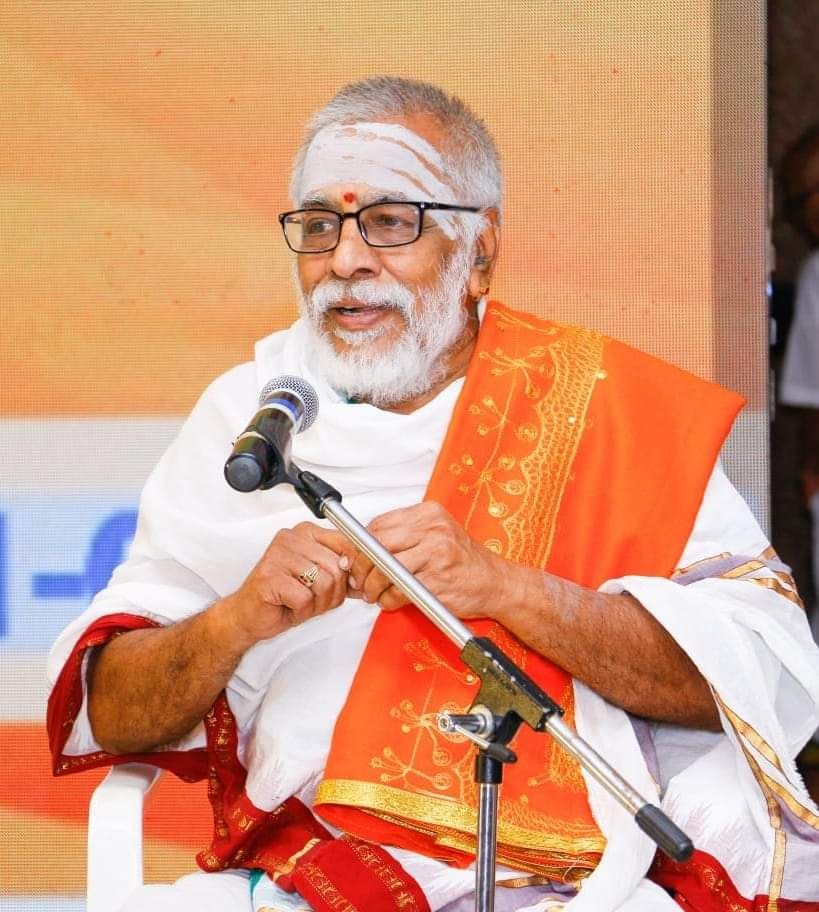
Sarma Sastrigal’s Journey in the Digital Age: Spreading Vedic Wisdom Through Social Media
 Sarma Sastrigal’s current vocation centers on sharing Vedic knowledge and spiritual teachings. Over time, his talks have become a regular feature, often inspired by questions from students or thoughts ignited during religious events. In his mission to help Hindus reconnect with their cultural heritage, Sarma Sastrigal utilizes both his home and public spaces to teach the Vedas and conduct programs. Through platforms like Facebook and YouTube, he has extended his reach far beyond Chennai, impacting audiences in India and across the world.
In his own words, Sarma Sastrigal emphasizes that the content of his speeches is not born of personal scholarship or “vidwat” (scholarship), but rather the wisdom of the scriptures he learned from his father and other great Acharyas.
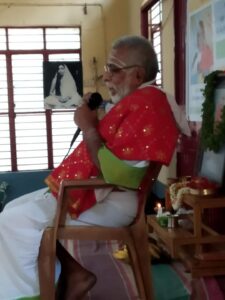 Sarma Sastrigal’s speeches are delivered in simple Tamil or English, making them accessible to a broad audience. Avoiding technicalities and extensive quoting from texts, his focus is on communicating in a way that resonates with the layperson—those with limited knowledge of Vedic scriptures. His messages are brief, with each session covering one topic at a time, making it easier for viewers to absorb and reflect upon. His primary audience consists of Hindus in their thirties and forties, whom he sees as crucial to passing on this ancient wisdom to the next generation.
Over time, Sarma Sastrigal has become a trusted figure, easily approachable and dependable for answers to questions regarding Sanatana Dharma. His practical advice, which is actionable and easily understood, has made him a popular resource. He is proud to have created a large, supportive community of students, both active and silent followers, who regularly engage with his teachings.
While some agnostics challenge the authenticity of his approach, questioning why different practices are seen across families and regions, Sarma Sastrigal remains unfazed. His response is one of understanding and open-mindedness: “Our religious practices thrive on multiplicity” he explains. While the core of rituals remains unchanged, variations naturally arise over time.
Throughout his teachings, Sarma Sastrigal maintains a firm belief in the universality of Hinduism. During an interreligious symposium in 2014, he boldly expressed his stance on religious tolerance. In his speech, he explained that Hindus, by nature, are open-minded and do not seek to convert others. Instead, the Hindu approach is inclusive without being intrusive—an essential aspect of Sanatana Dharma.
Sarma Sastrigal also highlights how the modern use of social media has enabled him to reach global audiences. While initially overwhelmed by the attention, he realized that these platforms allow him to make a significant impact and continue his work. However, despite his growing popularity, he remains grounded. The attention from fans and followers, such as encounters on his morning walks or amusing incidents like a follower’s wardrobe change due to his video on traditional attire, only serve to affirm the quiet transformation he has helped spark in people’s lives.
 Despite facing some opposition from traditional vaideekas who questioned the sanctity of using social media for spreading Vedic knowledge, Sarma Sastrigal stood firm. His belief is that a vaideeka’s duty is to keep our spiritual traditions alive and accessible for future generations. Over time, even those who were initially critical of his approach have come to support his efforts, with many other vaideekas now following his example and embracing social media to promote Hindu culture.
Sarma Sastrigal’s success in leveraging digital platforms is largely due to the support of his family and team, who have been instrumental in bringing his teachings to life. His daughter, Smt. Sowmya, introduced him to Facebook and set up his page, and his long-time student Sri. Omkar from the U.S. helped him take the first steps into YouTube, recording and uploading his teachings. With the support of his team, including his friend Sri. Sriram, who helps with video editing, Sarma Sastrigal has produced hundreds of short, impactful videos designed to engage and educate viewers.
Looking back, Sarma Sastrigal recognizes that his work, especially his use of social media to spread Vedic knowledge, is a gift from Bhagavat Sankalpam (God’s will) and the blessings of his parents. His journey is one of dedication to preserving and promoting Sanatana Dharma, and he continues to inspire thousands to do the same.
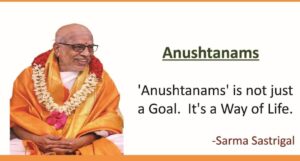 He has often emphasized the importance of following the prescribed daily, monthly, and occasional rituals as part of the journey towards moksha (salvation). In the words of Maha Periyava, Brahmins are expected to engage in these sacred duties, which lay the foundation for a life of devotion and spiritual growth. Sarma Sastrigal’s work reflects this ideal, with a special focus on karma yoga, or the disciplined observance of daily rituals, and bhakti yoga, the path of devotion, through pilgrimages and spiritual awakening.
In addition to his work with karma and bhakti yoga, Sarma Sastrigal has taken on the task of addressing the depletion of religious faith and the loss of traditional practices. A great amount of work in this endeavor has been through pravachanas (discourses) on our holy books including Bhagavad Gita. A lot of awareness has been created by Acharyas addressing lay people and showing them the bhakti marga and encouraging them to read the Bhagavad Gita and other texts and follow the principles contained in them. His aim is not just to teach religious theory but to offer practical, hands-on guidance for incorporating these practices into daily life.
Sarma Sastrigal’s contribution to this effort has been in two distinct areas.
• Karma yoga: organising programs to make people familiar with the karmas and doing them regularly, and
• Bhakti yoga: conducting teerth yatras, or pilgrimages in medium-size groups to holy Hindu shrines to experience the sanctity of the sthalam and soak in bhakti rasa.
Sarma Sastrigal’s work has always been grounded in the belief that lasting change begins with small, focused actions. He adopted a gradual approach to this task, focusing first on sharing his knowledge of Hindu traditions with a select group of people willing to listen and act upon the teachings. By keeping the scope modest in the beginning, he cultivated a sustainable foundation for his work. His deep involvement with the RSS further aligned his values with those of community service, unaccompanied by the desire for personal gain or recognition.
His programs, which include a wide range of religious workshops, seminars, and pilgrimages, focus on creating awareness, encouraging action, and facilitating tangible benefits. These programs have been intentionally designed to be accessible to people of all ages and backgrounds, fostering a sense of community and shared purpose. The workshops, often free of cost and accompanied by materials such as booklets and practice-related items, aim to instil the regular practice of traditional rituals.
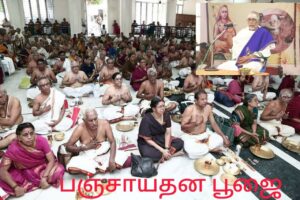 One of the distinctive features of Sarma Sastrigal’s approach is his focus on action-oriented learning. Rather than simply lecturing on religious observances, he encourages participants to engage directly with the rituals. This hands-on approach ensures that attendees leave with the confidence to practice the rituals on their own, fostering long-term commitment. The success of these programs is seen in the enduring changes they bring about in the lives of participants, who often share the knowledge they have gained with others.
The theme of Sarma Sastrigal’s programs is centered around three key philosophies or tatvas – AWARENESS, ACTION, and BENEFICIAL RESULT. The goal is for people to become aware of traditional values, take action to reclaim these values for themselves and their families, and for the community at large to experience the rich benefits of this steady transformation. Underpinning these three tatvas is an unshakeable faith in Hindu culture and Sanatana Dharma.
His team of volunteers, known as the A-Team, has successfully conducted a variety of programs in numerous cities and towns across India. Upon analysis, a distinct scientific pattern emerges in the planning, delivery, and post-program activities. They ensure success by following a tried-and-tested pattern.
Unlike those who rely on lectures, Sarma Sastrigal involves participants directly in the learning process by demonstrating tasks and guiding them through the entire procedure. This method ensures that there are no excuses for not making the practice a regular part of their routine. His programs are meticulously prepared, from selecting the appropriate venue to ensuring proper registration and timely execution. He places great importance on attention to detail, such as organizing seating arrangements, sound systems, and the comfort of participants, to create an environment conducive to learning.
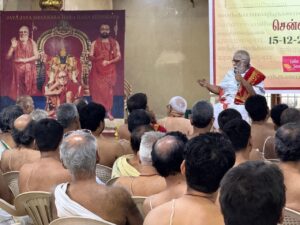
Inclusivity is a key aspect of his programs. He ensures that people from all sects and age groups, from young to senior citizens, feel welcome and comfortable. His workshops often attract a diverse audience, and he makes sure that all participants feel respected, regardless of their age or background. He even goes as far as personally visiting people’s homes to encourage participation, reflecting his commitment to reaching his target audience.
The administrative side of his programs is also thoroughly planned. Participants are given clear instructions about the event’s schedule, what to bring, and what to expect. Food, an important element of these programs, is provided, with a special emphasis on maintaining healthy habits, such as sitting cross-legged while eating.
Sarma Sastrigal’s approach is rooted in discipline, respect, and the belief that successful programs require attention to both the content and the surrounding logistics. His commitment to these principles has created an environment where participants not only learn but embrace traditional practices and integrate them into their daily lives.
The content of Sarma Sastrigal’s programs is carefully structured to ensure effective learning and engagement. Each session starts with a prayer or Vedic chant, followed by an outline of the agenda. He typically reserves his speech for the end of the program, where he recaps key points and imparts socio-religious messages. Sarma Sastrigal also addresses sensitive topics, such as inter-caste marriages and menstrual restrictions, with tact and respect for his audience, ensuring no discomfort.
Teerth Yatras
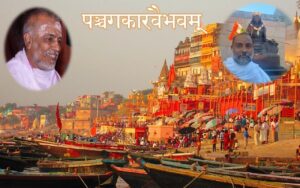 Sarma Sastrigal’s approach to organizing Teerth Yatras emphasizes both the spiritual and logistical aspects. They have been for the sole purpose of loka kshema (universal wellness) and propagation of Vaideeka Dharma. The tour parties have invariably comprised leading Ganapatigals, his students and their families. Sarma Sastrigal has so far done trips to Ayodhya, Omkareshwar, Mahakaleshwar, Kasi, Naimisaranyam, Rishikesh, Amarkantak, Tiruvannamalai, Adayappalam, Surutappalli, Srisailam and Pushkar.
Each yatra is carefully planned, beginning with choosing an auspicious time and location. He ensures the yatra aligns with important religious events, like the Pushkar Mela, and involves the performance of significant rituals at each destination. For example, in Pushkar, the group performed the Sampoorna Yajur Veda parayanam, and in Rishikesh, a Maha Rudra Parayanam. The program is designed not just to visit these places but to engage in religious offerings that deepen the spiritual experience.
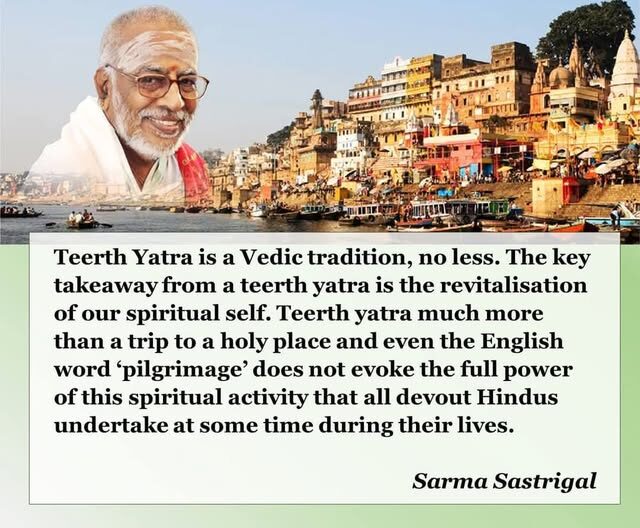
Yatras – The Takeaways
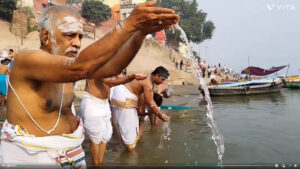
Planning the logistics is an essential aspect of Sarma Sastrigal’s yatras. He and his team scout the locations beforehand to ensure smooth travel, accommodation, and dining arrangements. Catering to the diverse needs of the yatris, the food is carefully planned, with regional delicacies included where possible, and the highest priority is given to serving pure vegetarian meals. The yatras also emphasize social responsibility, with activities like Anna Danam (donation of food) to the poor, and in Rishikesh, Go Danam (donation of cows) was also carried out.
During the yatras, there is a strong focus on religious practices and rituals, with the participation of priests and scholars who perform poojas, parayanams, and other sacred ceremonies. Sarma Sastrigal also ensures that the yatris visit nearby temples and cultural sites to enhance their understanding of the spiritual significance of the region. The discipline of time management and respect for rituals and customs is a key feature of the yatras, ensuring that all actions are carried out meticulously.
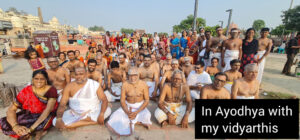 Every participant is encouraged to actively engage with the journey, spiritually and physically, ensuring they experience the full depth of the pilgrimage.
The takeaways from a Teerth Yatra are profound and far-reaching, offering spiritual, philosophical, and practical lessons that enrich one’s life long after the journey ends.
In essence, the spiritual growth that emerges from a Teerth Yatra is not limited to the rituals performed or the places visited. It is a holistic journey that revitalizes the soul, sharpens spiritual focus, teaches humility, and strengthens the bond with the divine. The lessons learned during these sacred travels stay with participants, guiding them through life’s challenges with a renewed sense of purpose and devotion.