Sarma Sastrigal's Students Speak
“The best teachers are those who show you where to look but don’t tell you what to see”
Alexandra K Trenfor
Aravind Hariharan
a senior executive working in the US
I will start with the transcription of a 3-minute video talk I aired on YouTube in August 2018 that can give you an idea of how I see Sarmaji and his momentous contribution to Hindus in general and Brahmins in particular.
“The Brahmin community is broadly classified into two – the vaideeka segment and the laukeeka segment. The vaideekas are responsible for six laid-down Vedic practices such as Yajanam, Yaajanam etc. The laukeekas do not do any of these but pursue lay professions.
Nevertheless, the laukeekas have religious duties to perform and practices to observe. A great danger is that if there is no effective, strong bridge between vaideekas and laukeekas, the laukeekas will slowly but surely abandon their duties and lose their Brahmanatva altogether. This threat to Hinduism is very real.
Recently I heard an old speech by one of our great Acharyas voicing the concern expressed above, and the first person I thought of was our Sarma Sastrigal (Sarmaji). Sarmaji is one person who tirelessly organizes programs to unite these two distinct parts of the community and to tell laukeekas about their dharmic responsibilities. He is doing yeoman service for the cause of Sanatana Dharma by persuading laukeeka Brahmins to do what they should do for attaining their spiritual goals.”
Every word I said in the video clip then is relevant even today.
Sarmaji’s methodology of teaching is customised to the needs of his students. While his group classes in Chennai attract more than a hundred students of all ages from young boys to retired men, his online classes on Skype that he started giving from the early 2000’s are one-to-one instructions. Typically, two lessons are given every week. He teaches for instance a panchadi of fifty words in one class and it has to be perfected by the students by the next class.
Even in his online classes Sarmaji creates the atmosphere of a real class by insisting that the students should have bathed and should present themselves in traditional attire.
I will close with a mantra that Sarmaji asks his students to follow. This is from Sloka 17 in the sixth chapter of the Bhagavad Gita. It says “those who are moderate in eating and recreation, balanced in work, and regulated in sleep will be able to mitigate all sorrows”.
S Bhaskaran
a retired bank employee
Though born in a Brahmin family, I never led a Brahmin’s life except having deep faith in God and being an absolute vegetarian. An inner voice kept telling me to learn Vedas for over 40 years, but I studiously ignored it till I met Sarma Mama in 2016 and started learning Vedas from him.
Mama has made me realize that being a Brahmin means more than chanting suktas. There are many more aspects of Sanatana Dharma that I have to learn and imbibe. My guru has come rather late in my life but he has helped me make good ground in the four years I have been his disciple.
The most inspiring thing about Mama is his uncompromising expectation of discipline from each of us in leading a true Brahmin’s life. And the parental affection with which he has inculcated this discipline in me has to be experienced to be believed.
He is compassion and friendliness personified to us – but not during the class hours! He is genuinely concerned about his students and their families, and makes sure we vidyarthis meet up with him at least once in three months. He takes us on yatras and organises parayanams at the kshetras to help us experience the spiritual grandeur of our nation. The atma-trupti that Sarma mama has given me is indescribable. He is truly God’s gift to me in this janma.
Delhi’ Srinivasan
Senior VP, Pharmaceutical industry
I connected with Sarma mama through Facebook in 2015 when I was in Delhi. I met him in Rajasthan Pushkar in 2016 when he came with his students for Sampoorna Yajur Veda Parayanam. It was late evening and he had been travelling the whole day but he was bubbling with energy.
Even with no connect he transformed my lifestyle completely from that moment. I learnt to wear pancha kachcham for poojas and samskaras.
I carry the pancha patram for doing sandhya vandanam when I go on tour. In 2018 I got a job in Chennai and became a regular weekend student in his house.
I am amazed by the way he teaches. Making elders unlearn wrong practices that they have been used to for years is tough, and an even bigger challenge is changing pronunciation mistakes. Mama does this with a single weapon – patience, mixed with humour.
I love driving and it has been my privilege to drive Mama to places like Kanchipuram, Tiruvannamalai, Amarkantak, Kumbakonam and so on, and enjoy his exalted company. It’s a pleasure to observe his clarity of thought on every topic he talks about.
A secret I would like to share is that nowadays when I take a sankalpa, I do it in the name of my guru, and it gets fulfilled. A related incident comes to my mind.
Once I was on an official trip to the US and it was the weekend. I was feeling bad that I was missing my weekend class, which I would have attended had I been in Chennai. Then it occurred to me to go to a nearby temple. To my delight and surprise a Veda parayanam was going on there! Not only was I able to chant along, but I got the bonus of an exceptionally good lunch! Mama’s bhakti towards Paramacharya and his Gurus is worth noting and emulating. He is as much a model disciple as he is a model tutor. He follows his Guru’s directions without any deviation. He has done many challenging programs just because his guru asked him to. An instance is his seeking outbrahmachari boys in Chennai and teaching samita danam – a task calling for
substantial physical and financial resources.
Sri Sri Bala Periyava once asked him to go to Gaya to check the facilities prior to a yatra. I was lucky to accompany him. For three days we travelled across Bihar. He researched the ins and outs of Gaya, and even met the state minister and submitted his memorandum on improvements needed at the Gaya temple.
On another occasion in Tiruvannamalai he was sick and slept in the car, all through the journey. But the moment he reached the venue he was his energetic self!
For Sarma mama loka seva (community service) and swadharma (one’s religious duty) are the two major principles that should guide one’s life. Krishna emphasises the same to Arjuna in the Bhagavad Gita. And mama does not merely preach this holistic truth but demonstrates it on every occasion.
Sarma mama is a veritable role model. The credit for my becoming his student should go to the piety of my parents.
Gurunatha Subramaniam
a student at Anna University
I am one of Sarma mama’s weekend Veda class students. My schooling was done in Oman, and after I joined college my father was keen that I learn the Vedas. Srinivasan Sir from KK Nagar, a family friend, told us about Sarma mama’s classes and I joined.
Mama is very knowledgeable about our Hindu culture and tradition, and apart from learning you also get the enthusiasm from him to strictly follow the religious practices required of you.
A great thing about mama’s teaching style is the personal touch he brings in. It’s not merely “here, chant this, practise it and come back”. You become his family member, literally. He will ask me “did you rehearse the anuvaakam I taught in the last class?” and with an impish smile he will pat me on the back and say “of course you would have!” How can a student treated thus take his lessons lightly?
The genuine concern he has for you extends to his caring for your personal health and happiness. I live in a hostel not far from the IIT Madras campus, and when mama saw the news about Corona infections there he called and asked me about my welfare, and urged me to take utmost care. To me it was like my own appa or thatha talking! Such love and affection from anyone is hard to come by.
Another sterling quality of mama is that he treats everyone equally, irrespective of age, social status etc. He gives no special privileges to anyone. I have consciously learnt this important attitude from him. But there is much, much more that I have to learn from Sarma mama and I pray God to give him longevity and give me the capacity to absorb the rich lore of our scriptures from him.
Karthikeyan V
a freelance yoga trainer from KK Nagar, Chennai
I chanced to see a post in Facebook in early 2016 about the Veda classes of Sarma mama and joined. It has been a great journey ever since.
At the time of joining mama’s classes I was doing nitya karmas and was considering learning Vedas as the next step. But after attending the classes I identified many shortcomings in my anushtanams. It was therefore a double bonanza for me, of learning Vedas and in parallel refining my anushtanams.
Mama works on his students like a diamond cutter works on raw stone by cleaving and sawing and eventually making it a diamond. This happens by tips he gives on various anushtanams in between the lessons, and also through the day-camps that he organises regularly. His energy and enthusiasm belie his age.
Mama gives us a long rope in assimilating his lessons, but on the basic qualifications for being a student of his, he does not permit any leeway: being punctual, adherence to dress code, regularity and correctness in karma anushtanam etc.
Life’s demands on a laukeeka are like heavy currents in which a boat gets tossed about in the river. Satsang with mama is the anchor that steadies your life’s journey and directs you to your spiritual goal. Thank you, mama!
Lakshminarayanan Sabarigirieesan (Sabari)
My introduction to Sarma Sastrigal was interesting. My father who was everything to me died and I was very depressed. At that time, I saw an unusual advertisement for a sandhya vandanam camp.
I was doing sandhi once a day routinely, so I wondered what they could teach me. I went for the program and discovered a big gap between the correct process of sandhya vandanam and how I was doing it. That was a turning point in my life.
As a corporate executive in an MNC I had convinced myself that I didn’t have the time for the learning of scriptures, doing pooja etc. But I had read ‘Deivaththin Kural’ where Maha Periyava strongly urges us to get back to the spiritual path. I asked Sarmaji how I could, given my long working hours.
He gently asked me to find time for all the observances commended by Maha Periyava. He first got me to do trikala sandhya vandanam, then made me add on brahmayagnam. He then taught me to chant Rudra-Chamakam and a few Suktas, and finally do Panchayatana pooja.
I have undergone a miraculous transformation. Not only can I find time for every single one of these activities but perform my official duties perhaps more efficiently than I used to!
Even after I moved out of Chennai I continue to regularly participate in many of his programs. I have often wondered how his events are so successful and what his formula is. I share my thoughts here:
• Sarmaji believes that inside every one of us the DNA of Veda dharma resides, and he evokes interest in us to realise this, and stimulate and nurture it by consistent practice.
• He never rushes his students but takes them along a carefully planned path.
• Sarmaji’s strategy is a beautiful blend of praachinam and naveenam (the ancient and the modern). I am reminded of the sayings of Sri Sri Bala Periyava on how we should use new tools to get back to our old traditions!
The greatest thing about Sarmaji is that every rupee collected for his programs and events goes towards the function only, and he touches no part of it. His simplicity and focus on the return of every Hindu to the spiritual path are great virtues that we should try to imbibe from him.
V S Mohan
Advertising professional, Chennai
Sarma Mama has an eye for detail, great regard to the finer aspects of any subject, and a keen sense of the ‘traditional’. Some reflections of these three qualities of his are:
- He is a stickler for neatness and professionalism in his meetings and programs.
- While making sandalwood paste on the occasion of annual ceremonies, he insists that the sandalwood is placed separately and not on the stone.
- He requests all married students in his Veda class to wear the panchakachcham. The uttareeyam is not to be forgotten too.
- He advocates the traditional dress at least while visiting temples, going for a darshan of Acharyas or visiting one’s ‘aathu vadhyar’ (house priest).
- He is particular about ladies observing ‘bahishtai’.
- He would demur if women wished to chant Vedas, as this practice is not blessed by the Sastras.
- Sandhya vandanam during travel is a strict no-no for him, as he considers cleanliness as a part of godliness.
- The seat used in rituals is not to be pushed by foot but only moved by hand.
- He often reminds us that a grhasta should never wear saffron robes (kaavi).
- He has taught many of us that brahmayagnam is a daily karma and not a tarpanam ritual
Sayeeram Subramanian
a senior IT manager, Chennai
I have been an online student of Sarma mama all along. I started learning Vedas online from him when I was working abroad and have continued with virtual classes even after returning to India. Mama is very flexible in adjusting his timings to suit my schedule changes. He never says no to a class even in tough situations.
As to why I joined his classes, rather than any individual objective I would say Mama kindled our responsibility to learn Vedas and gave us the platform to do the learning.
In my case a difference was I had been reciting Vedas using YouTube videos. Mama saw that I was unknowingly making many swara mistakes. He first stopped me seeing the videos and then made me see the necessity for the physical presence of a guru. He then took on the tiring task of correcting my errors. He persevered till I got everything right, and he did it without berating me.
Thanks to mama, many of us now listen to and chant Vedas instead of hearing and singing movie songs at home. This involuntarily influences the next generation of youngsters and children who are growing in this atmosphere.
Srinivasan Swamy
CMD, R K SWAMY BBDO
I must be among Sarma’s earliest students, if not the first, having started to learn Pancha Suktas in 2005 from him. Since we had known each other for two decades then, we were more friends than a teacher-student pair. I was already 50 then and I had no idea of learning any of our ancient texts. I was not competent to read the scriptures either in Sanskrit or Tamil. He boldly volunteered to teach me!
With enormous patience, he taught me the Suktas, Taitriya Upanishad, Nakshatra Veda Mantra, Punyahavachanam and a few other important oftused chants. We were not using on-line technology those days, and he would therefore come all the way to my house a few days every week. You could set the watch by the time he arrived – such was his punctuality!
After class, we would engage on other subjects of common interest and he would always show keen interest in all of them. I regard him as a man of extraordinary knowledge, with a gifted memory and the wisdom to match. His views would always be those of a true Hindu nationalist. This was reflected in his first book published in 2010 ‘The Great Hindu Tradition – an insight into Vedic Principles, Sastras and Heritage’ and several books thereafter.
Today he uses technology and social media like a veteran, and his speed and grip would surprise even a twenty-year-old. He has now emerged as a popular teacher and the go-to man to seek clarification on our religious practices.
I am privileged that he considers me his friend, while I can’t forget that he continues to be my guru.
Dr Sundar Swaminathan
a nephrologist in the US
We were fortunate to get connected to Sarma mama around 2014, when we were in Virginia, through a common friend who was learning Vedas from him. We had known about mama before that through his book ‘The Great Hindu Tradition’. I joined his class, and both my sons Ashwin and Sanjay are also learning from him.
Mama’s method and commitment are amazing. He teaches with passion and with a personal touch. He genuinely cares for his students. Mama has taken personal interest in our family, and has gone out of the way many times to help organise religious events in our family. A case in point is a ritual that needed to happen recently, which mama organized despite the COVID constraints.
Through his monumental efforts, mama has created a major impact on the society, awakening those who were dormant, rekindling their interest and making them realize the importance of our Vedic roots and culture. The impact of his work will last for generations to come.
Venkatachalam
AVP, Cognizant Technologies
Sarma mama is not concerned with his identity or visibility in what he sets out to do. His sole intent is the passing down of Hindu dharma to succeeding generations. For the past twenty-plus years he has been campaigning doorto-door, trying to motivate people to return to their traditional value systems. Sarma mama must have transformed at least ten thousand families. He is a brand in himself now and even though his work involves many personal sacrifices, he marches on like an untiring crusader.
Alathur Venkataraman
I am a student of Mama since Jul’18. Mr Bhaskar is our batch coordinator. Before Corona struck, our classes were live, on fixed dates and at fixed times. Each batch would have a coordinator and Mama would convey information through him.
Being a retired person I never missed a session. Now the classes are online and I continue to attend them. The learning has inculcated in me some discipline in my daily routine. The chanting of Rudram, Chamakam and other Suktas gives me great mental solace.
I see Mama’s posts on FB and YouTube. I get inspired by his explanations and direct enforcement of our rich culture in our day-to-day life. He explains everything in such a way that a layman can understand and follow.
V K Raman, Mumbai
I had the good fortune of noticing Brahmasri Sarma Sastrigal on Facebook a few years back. I was attracted by his efforts to inculcate spirituality in ordinary people.
The trigger for me to learn the Vedas was a nagging concern of mine while reciting Abhivaadaye at the time of doing namaskaram. We state during the chant that we have learnt the Veda we are born into – in my case Yajur Veda. I did not know Yajur Veda, and this was bothering me. Sometime in early 2017 I met Sarmaji at his home. I told him of my interest in learning the Vedas and he instantly agreed to teach me over Skype.
I live in Mumbai, so my classes have been online both before and after Corona. But when I visit Chennai I join the classes in person.
When I come to Mama’s classes I feel like a child being given playtime. I love the feeling of a Guru holding my hand like a mother and walking me through difficult portions. I find the passages amazingly easy when I am with my Guru. I started arranging my schedules for all other activities to suit Mama’s class timings. I give first priority to Veda classes and practice. For instance, I had a meeting at 9 am one day at my office. My Veda class was at 7:30 am and I knew I couldn’t finish it and travel to the office in time for the meeting. So I reached office at about 7 am, attended the class in traditional dress, and then changed to office attire well in time for the meeting.
Learning the Vedas has given my life a sense of purpose. I have become more time-conscious as I have to complete portions allotted for practice every day. This has led to my cutting out time-wasting activities. I have also become regular in performing Sandhya vandanam and Brahma yagnam.
My mind is more at peace. My family life has become more harmonious. I am able to grasp various issues comprehensively and clearly. This has made me more effective in both official and personal interactions. My actions are with much less ego and fewer expectations. This has helped me become pleasant and more useful to others. My outlook on wealth has changed significantly, and I now think more about to how to put it to good use as opposed to ways to accumulate more of it.
I have spoken about my experience with everyone who I feel will appreciate it, in office and to my relatives and friends. I wear this badge of honour with pride. Whenever someone asks me whether he can join I introduce him to Mama.
Sarma Sastrigal's Friends Speak
“Good friends are hard to find, harder to leave and impossible to forget” – G Randolf
N V Chalapathi
Headmaster, Zilla Parishad High School, Renigunta
I am very happy to take my memory fifty years back and reflect on those days when Sarma was a student coming in shorts to the school at Renigunta near Tirupati.
In my service as a teacher for more than four decades, I have come across many students but only some of them are fresh in my memory because of the close attachment at that time. Sarma is one such. As a student he was very quiet and obedient in school.
Since I am with a spiritual bent of mind I felt very happy when I came to know that Sarma at Chennai is very much transformed. Doing purohityam is really a valuable service. A popular Telugu poem gives four requisites for one to live in a place: a moneylender, a doctor, a perennial river and a Brahmin purohit.
I felt extremely happy when I learnt that he brought out a book on Hindu Dharma. I went through the book and felt that his writings with Vedic authority will surely satisfy the need for such information at a time when people are forgetting religious traditions.
Recently I learnt about his new project and I am sure he will be successful in this field of activity too. I pray God to shower his blessings and grace on Sarma and his friend.
Dr Padma Subrahmanyam, Managing Trustee,
Bharata Ilango Foundation for Asian Culture
Swaminatha Sarma – A Kaarana Janma
Sri Swaminatha Sarma Sastri was known to me as Sarmaji of the RSS and more so of VIGIL (a public opinion forum in mid 80s and early 90s). In 1992, our television serial ‘Bharatiya Natyasastra’ was telecast in Doordarshan, the national network. It was produced by our Nrithyodaya and directed by my brother V Balakrishnan. I had written the script and appeared in it.
I had no idea about the functioning of the RSS or VIGIL but my research on Natyasastra revealed the true history of our country and the integration that was immanent through the common Hindu cultural precepts. This was what our TV serial projected. I had used the song ‘Vande Mataram’ as thematic background music, whenever I was establishing the truth of having common roots of grammar for all the performing arts of Bharat.
We received a letter one day from VIGIL that Bharatiya Natyasastra had been awarded the ‘Panchajanya’ Award for propagating National Integration. It was from that time that my family came into close contact with Sarmaji. He was referred to as ‘Vigil’ Sarma.
In February 1999, Balakrishnan and I attended a VIGIL meeting on Demography, and I found the lectures thought-provoking. I decided to get all the Hindu Matadhipathis on one platform and make them speak out against religious conversion in one voice. That historic event in July 1999 termed as Dharma Rakshana Sammelan turned out to be a force to reckon with. I was the convenor of that ambitious project and Sri S Gurumurthy helped and guided me. Sarmaji worked tirelessly for the event. The Sammelan later evolved as Dharma Rakshana Samiti under the patronage and blessings of Pujyasri Swami Dayananda Saraswati.
VIGIL invited writers, scholars, thinkers and political analysts for thought and action on the future of Bharat, and created a stir in the society at various levels – social, political and religious. Sarmaji was its sheet anchor.
I understand Sarmaji has become a full time vaideeka, teaching and writing on traditional texts and processes. His short videos on YouTube have been creating awareness about the significance of many day-to-day Hindu customs. People like Sarmaji are chosen by God to come into the world as Kaarana Janmas and dispense their duties as nishkamya karma.
My hearty wishes to Sarma Sastrigal for many more decades of selfless service to Sanatana Dharma! May Veda Mata bless him with aayur-aarogya soukhyam (age, health and happiness) to guide many more into Desa Bhakti and Deiva Bhakti.
Srinivasan Swamy, CMD, R K SWAMY BBDO
Knowing Sarma in his Many Avatars
I have known Sarma from the early eighties when he was running a public opinion building forum called VIGIL. At that time, I just saw him as a very spirited person involved in public affairs. I did not know that he was a functionary of the RSS or that he had led many protests during the emergency imposed in the mid-seventies.
His endearing qualities, combined with his enthusiasm inspired me to get involved in many of the events that he hosted under the VIGIL banner. The abrogation of Article 370 and the Ayodhya temple dispute were subjects of serious debate. He conducted many seminars on various topical issues of the time and one that comes to mind is the National Seminar on Water Management. This was for the linking of all rivers and canals. Water harvesting, which became a buzz word in later years, was discussed in detail back then.
From 1980 I was in touch with him off and on till 2005, when I rediscovered him in his new avatar as Sarma Sastrigal. I took the opportunity to pursue some instruction in the Vedas from him for a few years. In 2009, I had the pleasure of encouraging him to write a book on Hindu tradition. The book was released by the revered Swami Dayananda Saraswati in front of a packed audience in Chennai. The book, ‘The Great Hindu Tradition’, has seen multiple reprints and has been translated into Tamil as well.
Sarma started the Loka Kshema Seva Samiti, a Trust to propagate Hindu thouht and scriptures. This has brought about a surge of people following his guidance and making him their ‘guruji’ in social and spiritual matters.
Mani Sivaswamy, a long-time family friend
Sarma Mama – A Multi-Faceted Personality
Sarma mama is our family vadhyar. My personal contact with him started when my father passed away in Oct 2008. He offered great comfort to my mother, my brother and me and guided us through all the rituals.
Sarma mama’s patriotic zeal, passion for national integration and in his earlier life his staunch devotion to RSS duties, are legendary. His years of youth were not without adventure. He once travelled all the way to Vietnam to conduct a friend’s wedding – not something I can believe of the Sarma Sastrigal I know today! Over the last decade-plus he has returned to traditional moorings and politely declines situations that demand his veering away from cultural roots.
As a vadhyar, Sarma mama was particular about making sure that whatever he earned was shared with the others who aided him and keeping only a small part for himself. He continues to live in a rented place. He respects the caste system because he sees it as a tool for carrying out varnasrama dharma as prescribed in the framework of Hindu sanatana dharma. Sometimes this is mistaken as favouring caste distinctions; but in reality, it is respect for classification of people based on their individual duties in order to keep society functioning optimally.
In his new avatar as a spiritual guide on social media, he has been able to reach out to a large audience world over with his fluency in Tamil and English. His forthright thoughts and outspokenness have disturbed the more conservative Vaideekas who probably see him as too outgoing. This is also perhaps a minor reason for his gradually giving up practising Vaideekam and concentrating on teaching.
In 2009, Sarma mama was diagnosed with cancer. I presented to him a book called ‘Love, Medicine and Miracles’ by Dr Bernie Siegel, hoping it would help him understand his condition better. I was amazed to see how well he recovered, thanks to his bold determination and matter-of-fact way of handling the serious situation.
During his illness Sarma mama compiled his now well-known compendium
‘The Great Hindu Tradition’. He has an uncanny talent for identifying the right
person for a task, and I saw this quality of his during this project.
I accompanied Sarma mama to Sankara Matham in Kanchipuram a few times. He was close to Pujyasri Jayendra Saraswati Swamigal (Pudu Periyava), whose interaction with the masses regardless of their status had a strong influence on him. You can see this approach reflected in the talks Sarma mama delivers on his YouTube channel.
His organisation skills are exemplary. Once, at a meeting, we left our footwear strewn near the entrance. Sarma mama came in after us and finding the scattered footwear gave us all a solid round of firing. He said if we could not even keep our footwear properly there was little chance of our doing the bigger task effectively. I learnt an important lesson that day: Little things are also important for a project’s success.
When Sarma mama’s son-in-law took a tough and courageous decision to relocate to Kumbakonam with his family to teach the Vedas in the Gurukula style, Sarma mama rose to the occasion and handled the situation with dignity, patience and clarity.
Sarma mama’s life is an evolving one and has seen any changes, but his strong convictions and his determination to work for the greater good of society are never-changing constants
H Raja, Politician, BJP Member and erstwhile RSS Pracharak
Sarmaji’s Service to the Nation
I know Sarma Sastrigal from the time he was simply Sarmaji. I was a Shiksharthi (trainee) in Rajapalayam in 1970, and one day Sarmaji who was functioning as pracharak in Kanyakumari came for a boudhik (lecture session in the RSS intellectual program) in one of our ITC’s (Instructors’ Training Camps). I still remember what he said that day.
“A mere eleven Muslims came on horseback and destroyed the entire Nalanda University with its 10,000 students and 1,000 teachers. That happened because each of the 11,000 people thought “they are 11 people and I am just one”. If they had instead thought “we are 11,000 and they are just 11”, Nalanda University would not have been razed to the ground. In fact even if each of them had remembered that they had two hands, 32 teeth and 20 nails they could have said “I have enough ammunition to fight”. This is the strength of mind, the kshatriya bhava that we should create in each one of us swayamsevaks”.
The words and the passion they carried could arouse even the dullest.
Later Sarmaji took over as zilla pracharak in our district itself and worked with Rajapalayam as HQ.
We should take Sarmaji as a role model and strengthen his hand in the exemplary work he is doing for propagation of the Hindu dharma.
V S Kumar, long-time associate in book-writing ventures
Sarmaji As I Know Him
Sarmaji came into my life in early 2010, coming home with a bunch of booklets on diverse topics related to the Hindu religion that he had written in Tamil. He wanted me to translate these into English. “Many Tamilians, especially Brahmins, cannot read Tamil and so I thought my booklets needed to be translated into English”, he said, continuing, “A compendium on our traditional values, rituals and samskaras would serve to answer a number of frequently asked questions about our religious practices.”
Then began an eight-month journey with him during which we compiled the book, ‘The Great Hindu Tradition’. During this period, I remember being in constant admiration and awe of this simple human being with a passion for propagating the greatness of the Hindu way of life to as many Hindus, particularly youngsters, as he could. The unusual thing was that he showed the passion only in his work and not by making fiery speeches or doing acrid debates or ‘patti manrams’.
Simplicity is Sarmaji’s middle name. There is no fanfare, no bombast in anything he does. And yet the results are breathtaking. What he has done by way of spreading knowledge about the Hindu way of life is the equivalent of a yaga. Take my case: a few months before I turned sixty, I told Sarmaji that my sixtieth birthday was approaching. I asked him how I should qualify myself to be eligible to celebrate my sashtiabda poorthi.
He said there were two things I had to be aware of from the perspective of Sanatana Dharma. “Sashtiabda poorthi is not merely a festive celebration but a ‘shanti’. You offer your gratitude to God for all the good years he has given you. And as for your eligibility, do you do sandhya vandanam regularly?” he asked. When I said I was quite irregular, he suggested that I perform the trikala ritual every day without missing a single time. “That would be a good starting point to get qualified”, he said with a twinkle in his eye. I am happy to say that I am one among the many he has persuaded to practise nitya karmas consistently.
Sarmaji has achieved enviable success in demystifying our religious duties to lay people and in transforming many of us in this current day and age. His method has five key elements:
- Perspicacity: He sizes up the person quickly and understands his touch points i.e. what resources can be tapped.
- Patience: He is never in a hurry, and takes one on the path at a gentle pace.
- Promotion: He constantly reminds us, in small but significant doses, of the importance of what we are doing and have to do.
- Persuasion: There is no dogmatism in Sarmaji’s advice. This makes his suggestions convincing and we feel like trying them out.
- Persistence: He never gives up. If he encounters a dead-end, he digs up an alternative path in no time.
Hats off to this remarkable spiritual mentor and his ceaseless vigil in preserving the great Hindu tradition!
Sarma Sastrigal's Family Speak
“They also serve who only stand and wait” – John Milton
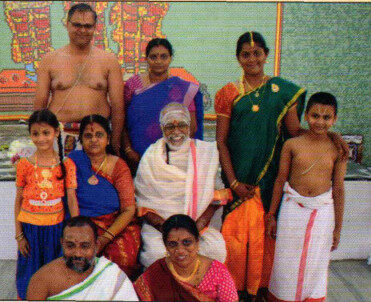

We have been married for over 42 years, and not unlike many women of my generation I stand quietly in the shadow of my husband. I try to be a source of strength to him and to all that he is engaged in, so much so that the saying “behind every successful man there stands a woman” may be justified in our case!
I come from a very reputed family of Chennai. I lost my father when I was very young, and was brought up by my mother and two uncles (mamas). Both my mamas have been strong influences in moulding me as a strong, silent woman.
One of them, Sankaran Mama, led a life deeply influenced and guided by the Sastras which later gave him the status of a realized being – a jivanmukta. He became my husband’s guru. The other, Ramagopalan Mama, who passed away in October 2020 at the age of 94, will be forever remembered for his trailblazing work in the RSS from the forties all the way till his death. His deep devotion for the motherland was awe-inspiring to me and to all of us when we were growing up.
My two daughters Sangeetha and Sowmya were my main focus of attention before they were married off. This was not only because I was their mother but also because my husband’s involvement with the RSS took him away on frequent calls for service to the nation, and I had to hold fort at home.
The most notable of these were the Kar Sevas for the Ram temple in Ayodhya. I realized that I had to show my solidarity and alignment to what was precious to him. It was my good fortune that I could accompany him on one of the Kar Sevas and help transporting bricks to the site of the temple! I could afford to go because Sangeetha and Sowmya could more or less take care of themselves by then.
My severest period of trial was when my husband took seriously ill in 2009. I summoned all my reserve strength to be able to provide him assurance and comfort. You can imagine that I was deeply worried for him but it would have been wrong on my part to let my husband catch a whiff of my anxiety. God was with me in overcoming the ordeal with success.
I continue to be a silent source of support to my husband’s vaideekam and his extensive spiritual mentoring activities. While he is teaching, I do my duties around the house mostly staying out of his way so as to allow him to carry on undisturbed in his efforts to educate a number of students in the Vedic way of life. I don’t involve myself in his work.
His lessons have influenced my life as well, and the prescriptions of our Sastras mean a lot to me. For instance, I do all the housework myself as it is hard to find a housemaid who will abide by rules of womanly cleanliness especially at times of their monthly cycles. My husband travels to places of pilgrimage with his band of students quite frequently. I do not usually join because these travels take a toll on me physically and I don’t want to become a nuisance. I therefore prefer to remain in my own space.
In our growing years Appa was a wonderful father to us and he continues to be one. Owing to his long hours on VIGIL work he spent very little time with us, but showered love on both of us. Appa’s hectic schedules would sometimes mean that we would not see him for days on end, but we never missed him. The brief interactions we had were imbued with affection and care for our education, our growth concerns and later our career and marriage.
I remember my grandmother (Appa’s mother) telling us “A kid is a kid till three years of age”. After that age responsibilities had to be inculcated slowly and steadily in the child. This was the disciplined approach in our family when it came to bringing up kids, and ‘achu-pichu chellam’ (doting on the child to the extent of spoiling him or her) was strictly a no-no. Only the best was given to us in everything. Good homemade food, nice neighbourhood with sharing cousins and loving grandparents combined to make our childhood truly magical. Appa was always focused on our good health, hygiene, good habits and the right kind of exposure.
When we were very young, appa had a big bicycle that had a baby seat in it. Sowmya and I would love to sit on that and go for rounds with appa. When we went to high school he would attend parent-teacher meetings and hear our teachers talk about us, but he never pressured us for marks.
We were never afraid of admitting our mistakes to appa. We were given full liberty to express contrary views on a subject and argue our side. Once appa scolded me for something he found wrong or missing, I don’t remember precisely what it was. Amma clarified to him that it was not my doing. Appa did not hesitate to say sorry to me for the misunderstanding. These are in my view incomparable values to teach your children.
One day amma made delicious, soft idlis that Sowmya and I loved and kept hogging. After finishing the meal I went proudly to appa and told him how many idlis I had eaten. He didn’t like it and said gently “it’s wrong to measure how much you eat. Please don’t do it again” and explained the reason. I learnt a valuable lesson that day.
Appa’s spiritual foundation and ethos are very strong. We had been to Tirupati once 30 years ago and an incident that happened during the visit will give you an idea. It gives me goose pimples even now when I recollect the incident.
Sadasivam uncle, appa’s close friend who was the Deputy Executive Officer of TTD, had organised our visit. We had completed the darshan and were coming back. Adjacent to the Yoga Narasimha there is a pillar with Anjaneya on it. Everyone makes a pradakshina (circumambulation) of the pillar. Uncle asked us to sit at the Yoga Narasimha graha and wait for him to finish some work and return to take us. Appa sat down in front of the Yoga Narasimha and started doing puja. There was no one in the vicinity except me, and I was sitting two feet away. Amma and Sowmya were also not there.
Suddenly a tulsi mala (garland of basil) fell on Appa’s lap. We didn’t know where it fell from. No one could have thrown it as there was none nearby. I went to appa and asked him to give me a few leaves from the mala. Some people who were doing the Anjaneya pradakshina saw me extending my palm to receive the tulsi and came with outstretched palms and soon a queue formed. Many of them were saying “Narasimha has given the tulsi to us” and were in a bhakti trance. The icing on the cake was that amma and Sowmya also joined the queue!
A memorable event highlighting his patriotism is his going for Kar Seva in Ayodhya in the 1990s. Amma, Sowmya and I went to the railway station to see him off, and saw there hundreds of men and women with whom he was going. We knew it was a dangerous expedition but none of us were sad, there were no emotional outbursts. The knowledge that appa was going for a great cause overrode personal concerns even at that young age for both me and Sowmya! I am narrating this as an example of the stoic approach to life Appa instilled in us.
After forty days or so, appa returned home on a rainy night, without notice. That was when we all cried with joy on seeing him. The rasagulla tin in his hand – the family’s favourite sweet – doubled our jubilation.
I had adolescence issues in my teen years. I was a scaredy-cat when it came to talking to boys, for example. Appa patiently taught me how to face up to frightening situations, and how to take a firm stand while being civil and polite.
It was perhaps the grooming by Appa and Amma that made me and my husband take what many consider a mature, tough decision regarding our son’s education. I have sent him to learn Vedas in the Gurukula tradition at the Veda Patasala run by my brother-in-law in Kumbakonam. Appa’s farsighted decisions in his life must have been working in my mind to decide that Veda education was important to my son, and that I should not be swayed by the ‘here-and-now’ compulsions of the society around me.
I would conclude by saying that appa gave us his time and energy unconditionally. He moulded us with his thoughts and ideas. He gave his best to us. He stands tall.
Appa has given us some great memories to cherish our childhood. Whenever our public exams approached appa would arrange for extra tuitions to rid us of anxieties. He even tried to teach us Telugu himself. I recall how we both – Sangeetha and I – were playful and would try to dodge him and the tutors!
As regards my present life as a Vaideeka’s wife, and my additional role of a ‘mother’ to 20 children in the Veda Patasala, I can only say it is very fulfilling. My husband has taken on the tough challenge of imparting Vedic education in today’s world, and it is my duty to support his selfless work in every way I can. To keep the education relevant and interesting to the children, he regularly discusses with pundits and Acharyas and makes modifications as required. His impressive array of references has made it possible for him to not only reach great value to the boys learning now but excite interest in
many other parents who are keen to enrol their children.
My daughter Sheethala wants to add here that her grandfather is a huge influence on her and that while he is very loving, he is very strict at times. But she says with great maturity that it’s for her own betterment, so she doesn’t mind. Wise words from a young girl! Proud of you, my baby!