The Spiritual Makeover
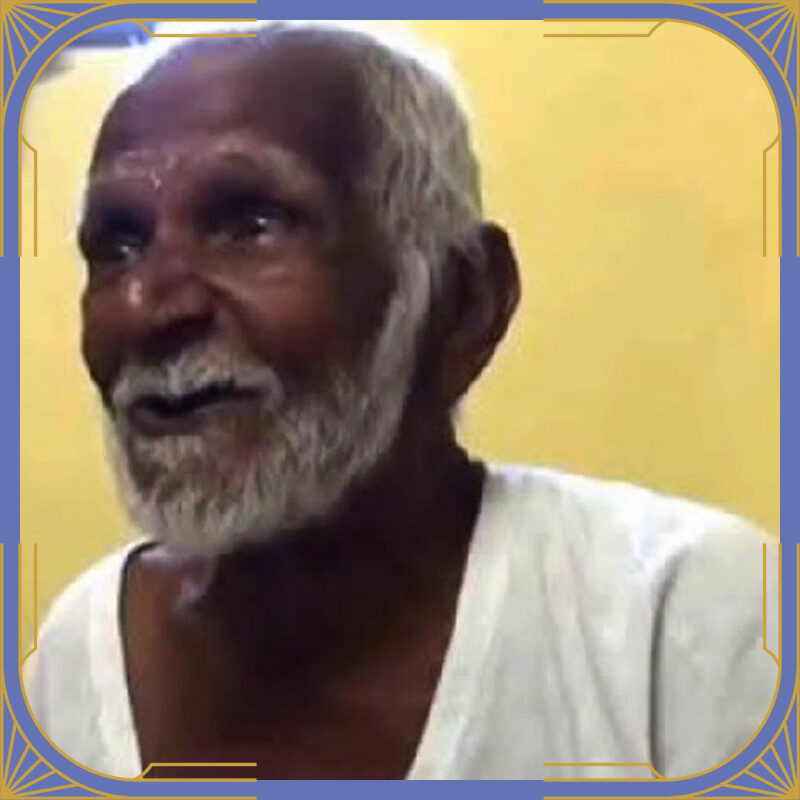
The acceptance of a disciple by a guru, Sarma Sastrigal learned, happens long before the disciple is aware of it. It is always the guru who decides when the time is right. In Sarma Sastrigal’s case, his persistence and unwavering faith ultimately led him to the grace of his master
Sarma Sastrigal, led a life deeply rooted in his Brahmin heritage. Despite his involvement in various activities, he remained steadfast in his adherence to religious traditions. His daily nitya anushtanams were performed with unwavering sincerity and dedication. From a young age, he studied the Vedas under his father’s guidance, though he had not completed his studies at that time. It was only after resigning from his position at Ashok Leyland that he rekindled his passion for the Vedas, rejoining his father’s morning classes for office-goers. Each morning, he would travel from West Mambalam to Nanganallur to attend these lessons, reinforcing his spiritual foundation.
Yet, despite this commitment, Sarma Sastrigal felt an unfulfilled longing, an absence of a personal guru who could provide the guidance he sought. Great acharyas like Maha Periyava of the Kanchi Kamakoti Peetam were of course there to give direction, but they were, as sanyasis, not in a position to become personal guides. I had many questions in my mind, many doubts and felt a mentor close at hand was crucial.
It was during a conversation with his close friend, Sri Rama Gopalan, affectionately called Gopalji, that he expressed this desire. Half in jest, he chided Gopalji for not assisting in his search. To his surprise, Gopalji laughed and remarked, “You are carrying the butter in your hand but looking for ghee,” a Tamil saying implying that what he sought was already within his grasp, merely requiring refinement.
Gopalji then revealed that his own elder brother, Sri Sankaran Iyer, was the very guru Sarma Sastrigal had been searching for. This revelation came as a shock — Sarma Sastrigal had known Sankaranji for over two decades but had never recognized him as a spiritual mentor. Gopalji emphasized that his brother was no ordinary man but a jivan mukta, one who had attained liberation while still in his physical body. The claim was astonishing, but Sarma Sastrigal’s instincts told him it was true.
Determined, he set out to meet Sankaranji. However, upon his arrival, he was met with an unexpected response. Instead of welcoming him warmly as usual, Sankaranji turned away and retreated indoors. Sarma Sastrigal found him watching a Tamil film song-and-dance program with the children — a surprising sight that seemed out of character. In retrospect, Sarma Sastrigal realized that this was a deliberate attempt to deflect his newfound perception and test his resolve.
Their initial interactions were casual, with Sankaranji showing no indication of accepting him as a disciple. Over the next six months, Sarma Sastrigal faced repeated rejection. Every attempt to seek mentorship was met with resistance. However, he did not waver. Gopalji had forewarned him that his brother would initially push him away, testing his determination.
Finally, after months of perseverance, Sankaranji acknowledged Sarma Sastrigal as his disciple. The moment of acceptance brought Sarma Sastrigal immense joy and relief. Years later, when Sarma Sastrigal asked why he had been made to endure such trials, Sankaranji responded with a cryptic yet profound explanation: “When did I ever let go of you? The reins were always in my hands. I just let the ‘cow’ wander around to exhaust his prarabdha karma before reining him in.” It became clear that the journey had always been under his guru’s watchful guidance.
Reflecting on the past, Sarma Sastrigal recalled an incident from 1978, when he married Vijayalakshmi. As they prepared to leave for Tirupati, it was Sankaranji who carried their bags to the station and saw them off. At the time, Sarma Sastrigal had not realized that his future guru had symbolically been carrying his burdens long before he became his disciple.
The Decision to Resign
The guidance of Sankaranji played a crucial role in shaping Sarma Sastrigal’s life-altering decision to resign from his job. After spending 15 years at Ashok Leyland, he felt an overwhelming urge to leave. The choice was not merely about embracing vaideekam, a profession his father had long encouraged, but also about a growing discomfort with his daily corporate routine. Despite the financial stability and respect his job provided, he left without a clear plan for the future.
For a time, his life consisted of family responsibilities, social service, and daily mentorship under Sankaranji. He would visit his guru’s house each morning for walks and profound conversations. However, financial hardships soon surfaced. His savings dwindled, forcing him to explore various means of livelihood, including small-scale businesses and computer-related ventures. Unfortunately, none proved sustainable.
Sarma Sastrigal found himself in dire straits. Providing basic necessities for his family became a struggle. On one occasion, he boarded a bus to Teynampet, only to realize he lacked sufficient fare. With only two half-rupee coins, he chose to disembark and walk home rather than face embarrassment.
In moments of intense frustration and suffering, Sarma Sastrigal often found himself lamenting, “Siva Siva! What have I done to deserve this?” He would confide in his guru, Sankaranji, expressing his deep vexation. Sankaranji, however, never offered any material help, but rather responded with a serene smile, blessing him with vibhuti and encouraging him to bear his struggles. At the time, Sarma Sastrigal did not understand why his guru did not intervene more directly. It was only with time that he realized Sankaranji’s wisdom: the guru had given him the greatest help by not offering quick solutions, but instead guiding him toward spiritual knowledge.
Sankaranji helped him understand that enduring the pain caused by his prarabdha karma (destined actions) would be far more beneficial than avoiding it, as facing it head-on would free him from the cycle of rebirth.
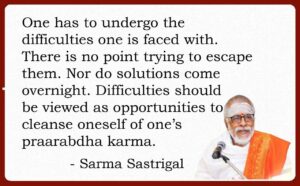
This experience echoed the teachings of Srimad Appayya Dikshitar, a great saint whose own life was marked by perseverance in the face of suffering. Sarma Sastrigal often reflects on a story from Dikshitar’s life, where the saint, despite being in excruciating pain, would endure the discomfort rather than allow his affliction to grow and become insurmountable in the future. This story deeply resonated with Sarma Sastrigal and shaped his understanding of the importance of confronting life’s hardships with resolve.
During this period of hardship, Sarma Sastrigal also learned the invaluable lesson of seeking counsel from one person and confiding in them. For Sarma Sastrigal, that person was his guru, Sankaranji, who provided him with the emotional and spiritual guidance necessary to navigate his difficulties.
Linking back to the roots
A pivotal moment in Sarma Sastrigal’s life came when Sankaranji asked him a simple but profound question: “How often do you see your parents?” This question led Sarma Sastrigal to reflect on his relationship with his family and the importance of reconnecting with them. He was living away from his parents in Nanganallur at the time, seeing them only once a month. Following his guru’s advice, Sarma Sastrigal began visiting his parents daily, which set in motion another significant transformation in his life.
One morning, after following his guru’s suggestion, Sarma Sastrigal visited his father and, almost unexpectedly, asked to restart his Vedic studies under his father’s guidance. Initially, his father was skeptical, but his mother encouraged the endeavor, urging him to learn what he had always intended to. Thus, Sarma Sastrigal began his studies under his father’s tutelage, embracing the discipline of Vedic learning and preparing for a new chapter in his life.
As Sarma Sastrigal delved deeper into Vedic studies, he found himself drawn not only to the sacred texts but also to their applications in rituals and ceremonies. His first test came when his father, ill and unable to perform a crucial religious ceremony, entrusted Sarma Sastrigal to conduct the ritual. Sarma Sastrigal rose to the occasion, conducting the Amavasya tarpanam with such dedication that his father, though unwell, observed with approval. This experience marked the beginning of Sarma Sastrigal’s journey as a vaideeka, a spiritual practitioner, and his life began to shift toward his true calling.
Financial Distress and the Loan
Despite his newfound spiritual path, Sarma Sastrigal faced immense financial difficulties. He had accrued significant debts, and his situation seemed dire. It was at this low point that a dear friend, Sundar, came to his aid. Sundar lent him a substantial sum, allowing Sarma Sastrigal to pay off his debts and begin anew. Sarma Sastrigal’s gratitude for this selfless act of kindness became a pivotal moment in his life. His financial struggles gradually abated, and his work as a vaideeka began to gain recognition, allowing him to rebuild his life.
As his reputation grew, Sarma Sastrigal sought the blessings of the Kanchi Acharyas, including Pudu Periyava, who expressed happiness upon hearing of Sarma Sastrigal’s decision to pursue the vaideeka profession. Sarma Sastrigal’s involvement in the prestigious Ati Rudram ceremony in Kanchipuram further solidified his standing in the vaideeka community.
Throughout this period, Sarma Sastrigal’s wife, Vijayalakshmi, played an essential role in managing their finances with prudence, allowing Sarma Sastrigal to focus on his spiritual work and the repayment of his debts. Despite the hardship they faced, Sarma Sastrigal’s family stood by him without complaint, a testament to their unwavering support.
Years later, after Sarma Sastrigal had regained his financial footing and built a successful career, he repaid his friend Sundar, who was surprised by Sarma Sastrigal’s dedication to fulfilling his debt. Sundar’s wife, in a lighthearted moment, asked Sarma Sastrigal to teach her husband Vedic knowledge as a form of “interest” on the loan. Sarma Sastrigal agreed, and thus began Sundar’s journey into Vedic learning, further reinforcing Sarma Sastrigal’s belief in the power of selfless acts and spiritual mentorship.
Father’s illness and demise
Sarma Sastrigal’s father, Brahmasri Srinivasa Sastrigal, was a towering figure in his life, a man of unwavering dedication to Vedic learning and religious practice. As his father’s health declined, Sarma Sastrigal had the privilege of caring for him in his final days. Even in his illness, Sarma Sastrigal’s father remained committed to his rituals, performing a tarpanam in the hospital using sand as a substitute for sesame seeds. This act of devotion left a lasting impression on Sarma Sastrigal, reinforcing the importance of ritual and spiritual integrity, regardless of external circumstances.
In the days following his father’s passing, Sarma Sastrigal took on the responsibility of performing the apara karma for his father, fulfilling a sacred duty that he was uniquely prepared for as a Vedic scholar. Sarma Sastrigal viewed this as a divine blessing, an opportunity to honor his father’s legacy in the most profound way possible. He reflects on this as a moment of deep spiritual significance, where his own transformation to a dedicated vaideeka culminated in the rare honor of performing the Brahma medha samskara for his father.
What we do by way of karma for our parents when they die is known as ‘pitru medha samskara’. But if the person who dies has done Veda adhyayanam in his life, and if his son who does the apara karma is also a Veda adhyapaka, the karma is called ‘Brahma medha samskara’ and is a more sanctified ritual
Evolution as a Sought-After Vaideeka
As the demands of performing upadhyayam grew, Sarma Sastrigal found himself busier than ever. What set his practice apart was not just the precision with which he performed the rituals or the clarity with which he recited mantras, skills developed through his father’s meticulous training, but also the comfort and sense of fulfilment he was able to offer to the karta — the person performing the ceremony.
From the start, he made it a point to understand each family’s unique traditions. He would inquire about their ancestral practices, the do’s and don’ts passed down through generations, and their personal preferences. Most families were clear about their customs, and he showed deep respect for these traditions, recognizing that every family had its own distinct approach to rituals. He always emphasized the sacredness of the aathu vazhakkam, except when it contradicted the fundamental rules of the ritual itself.
He also understood the diverse circumstances of his clients. Whether it was space constraints or financial limitations, he would always make allowances. However, if something clearly violated the rules of the ritual, he would gently but firmly suggest a change. In nearly every case, the clients were grateful for his guidance and willingly made the necessary adjustments. There wasn’t a single instance he could recall where a client refused to cooperate; and if ever such a situation arose, he would courteously excuse himself from the ritual.
Over time, he developed some personal guidelines for his work:
- Traditional Garments: Pancha Kachcham and Madisaar must always be worn during rituals.
- Time Commitment: The time required for the ritual cannot be compromised.
- Involvement of the Lady of the House: The woman of the household must actively participate in the ritual, as prescribed.
- Fair Compensation: The sambhavanai paid to the vaideeka and Brahmanas must be fair, and he would not tolerate any attempts to bargain.
When it came to fees, he held firm in his belief. If a family was financially limited but committed to performing the ritual correctly, he would offer his support, sometimes waiving his fee or accepting only a token amount. However, if a family had the means, he felt they should honor the significance of the ritual by paying the appropriate fees without hesitation. His combination of soft persuasion and firm authority led most families to understand and follow his reasoning.
One principle he held dear was the involvement of the lady of the house. In families where religious practices like daily rituals and ancestral rites were performed regularly, it was often the woman who ensured their continuation. He had seen many men, indifferent to the rituals themselves, still participate because their wives insisted. He often referred to this as the unique Hindu Brahmin version of “woman power.” On the contrary, when the lady of the house lacked interest, the entire family would often cease the practice of rituals altogether.