Conquering Cancer
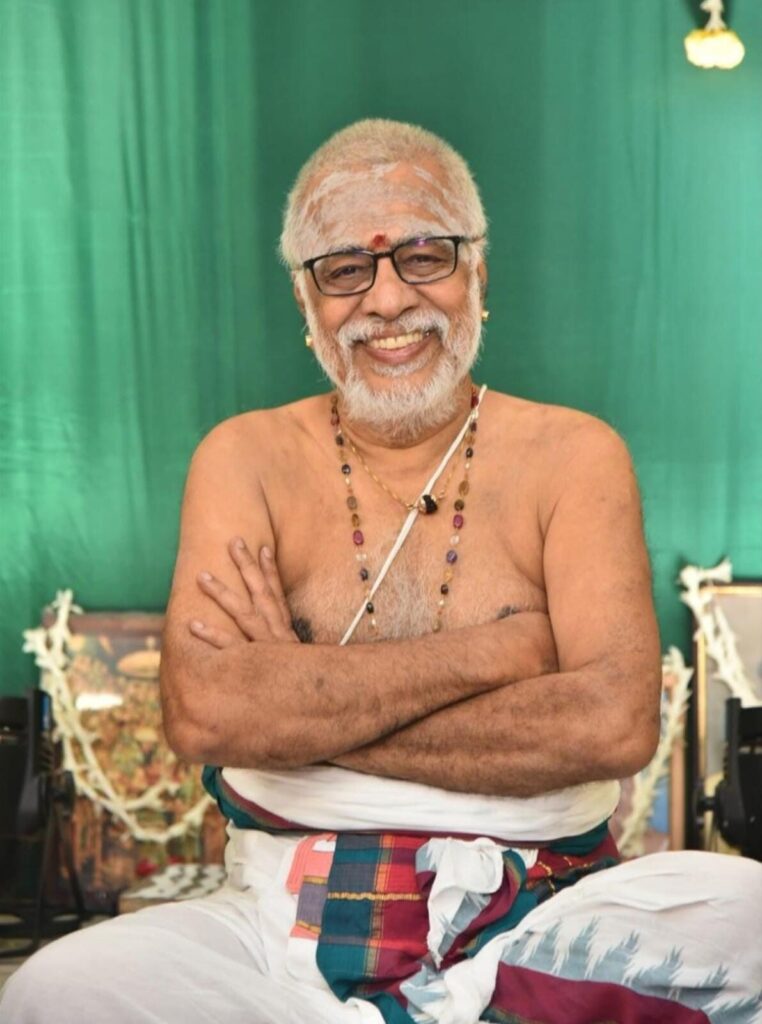
So how does one overcome fear? Sarma Sastrigal believed that anchoring the mind in faith and trust in God’s grace could dispel fear. Accepting suffering as a consequence of past karma (prarabdha karma) and facing challenges with resilience was, in his view, the best approach to adversity.
At the core of Sarma Sartigal’s life is his cherished family. He shares a deep bond with his wife, and is a proud father to his 2 daughters. His close relationship with his siblings, reflects the strong family ties that have shaped him. Guided by the wisdom and values of his father, Sarma Sastrigal continues to draw strength and inspiration from those closest to him.
His Marriage
His father, a stickler for austerity, made it clear that there would be no printed invitations for the wedding. Only 15 persons on each side, of the bride and bridegroom were present, somewhat like a COVID-era marriage. No mantapam (hall) was hired; the venue was the residence of Sarma Sastrigals wife’s sister. Silk was eschewed. The event was not photographed. The emphasis was on the meticulous performance of all the rituals associated with a Brahmin vivaha (wedding). The theme of his wedding was simplicity and religious discipline.
Huge spending on fancy invitations, entertainment, and gifts, along with the colossal waste of food that he observed in many Indian weddings, pained him a great deal. It was particularly distressing for him to see that, in most weddings, the religious rites were glossed over, mindlessly rushed through, or even skipped altogether.
His Wife
Smt. Vijayalakshmi, his wife, came from a reputed family. She had lost her father at an early age and was brought up by her mother and two maternal uncles, Sri Sankaran, who later became his guru, and Sri Rama Gopalan, the legendary RSS leader.
Thanks to her upbringing by such stalwarts, it was no surprise that Smt. Vijayalakshmi was, and continues to be, a strong woman with immense character. He believed that she gave him the unspoken courage to step out of his comfort zone in pursuit of complex projects. She never needed to say a word, but the mere fact that she stood by him was enough.
With most of his spare time devoted to his RSS duties, the responsibility of managing the household and raising their daughters fell almost entirely on Smt. Vijayalakshmi. While he did spend quality time with them when he was around, these moments were infrequent.
He also saw in his wife a person with deep conviction in national causes and the courage to risk her own comfort for them. She saw him off confidently when he embarked on the Ayodhya “do or die” mission and later even accompanied him on a Kar Seva. She subsequently played a crucial role in helping him battle cancer with unwavering strength and fortitude.
His Daughters
As mentioned, he left the details of raising and nurturing his daughters, Smt. Sangeetha and Smt. Sowmya, almost entirely to his wife. Seeing the high values they had imbibed from her filled him with pride and contentment about how they had managed their lives.
He was not one to be overly indulgent with his daughters. His affection never extended to “spoiling” them, what is known in Tamil as “chellam koduppadhu” was not part of his approach, nor was it his wife’s. If anything, she was even stricter.
Like his parents before him, he and his wife gave their children the freedom to decide their own paths. However, he would also offer guidance, cautioning them about the pros and cons of any major decision, whether related to their education, career, or marriage.
For him, his wife and daughters were truly priceless gifts from God.
His Siblings
His elder brother had continued working at the Madras Port Trust (MPT) in Chennai until he opted for voluntary retirement as an Assistant Engineer. He had one child.
His brother’s life took a sudden and unexpected turn that no one in the family had foreseen. Despite having a family and property, he chose, one day, to take early voluntary retirement and become a sanyasi.
He took sanyasa deeksha on the banks of the Ganga in Haridwar and lived there for several years, intending to make it his permanent home. The family implored him to return, assuring him that he could continue to be a sanyasi while staying close to them. After much persuasion, he finally returned to Chennai but chose to live in an outhouse adjoining his home, completely distancing himself from his family and relatives.
His elder sister had three children and lived in Pudukkottai, while her 3 children settled in Chennai.
His Father
His father remained a dedicated vaideeka and Veda adhyapak until the very last days of his life.
Battle with Cancer
In 2009, Sarma Sastrigal was faced with what many refer to as the ‘Big C’ — cancer. A nodule in his neck had been bothering him for some time, and when he finally consulted a doctor, it was confirmed to be cancerous.
The word cancer often instills fear, and that fear, he believed, only worsens the condition, much like a batsman facing a reputed bowler with hesitation. He maintained that if one could shed fear and face cancer with courage, the disease could be overcome.
The tumor in his lymph node was painless but persistent, prompting him to seek medical advice. The doctor suggested a biopsy, and when the results came in, he was called to the clinic. The doctor, visibly hesitant, confirmed the diagnosis. Unshaken, he simply asked what needed to be done next. Upon returning home, he informed his wife, who, without a trace of fear or distress, promptly suggested reaching out to Sudha for recommendations on a good hospital.
When he visited Sudha’s house, he smilingly referred to his diagnosis as a “divine gift.” After reviewing the report, she quickly sought medical advice, and soon, it was confirmed that while the cancer was serious, it was treatable. He then visited the Cancer Institute in Adyar, accompanied by his elder daughter, Smt Sangeetha. After two days of testing, his chemotherapy treatment began.
The treatment lasted an entire year, and though it brought immense suffering, he never lost faith in God. His family stood firmly by his side, providing unwavering support through every difficult moment. The possibility of both survival and loss was clear to all, but he chose to face it with acceptance and strength.
During this period, he underwent a bone marrow test to ensure the cancer had not turned malignant. The attending doctor, surprised by his calm demeanor, asked why he showed no anxiety. In response, he simply stated, “Why should I be fearful? If something happens, so be it.” He further remarked that God had given him sixty fulfilling years, and whatever followed was also his will. Touched by his words, the doctor embraced him, though the sudden hug made him cry out in pain, an exchange that ended in shared laughter.
After nearly ten months of treatment, he was ready to be discharged. As he prepared to leave, Dr. Jagannathan, his treating physician, asked him to wait. Once the attending nurse had left, the doctor removed his shoes, washed his hands, and prostrated before him. Taken aback, he asked why the doctor was bowing to him. The doctor simply replied, “God has given me the rare privilege of treating you. I have treated many patients, but it was a special joy to be your doctor.”
His approach to battling cancer was later affirmed by a close friend, Mani Sivaswamy, Vice-President of a major pharmaceutical company. Mani gifted him the book Love, Medicine and Miracles by renowned oncologist Dr. Bernie Siegel, noting the similarities between the book’s philosophy and his own outlook. Dr. Siegel emphasized that fear of cancer was unnecessary and that miracles do happen for those who maintain faith.
At the onset of his illness, he had no prior experience with cancer or how to deal with it. However, he refused to panic, as Dr. Siegel had advised in his book. One striking story from the book described a cancer patient who, despite receiving treatment, worsened due to her own fear and doubt. To help her overcome this, her doctor shaved his own head and pretended to have cancer, successfully inspiring her to believe in her recovery.
Reflecting on his own experience, he had never spoken publicly about his illness before but felt it was time to share his message, Cancer is not something to be feared. With strong support systems, like the unwavering strength of his wife, who bore the burden of his illness like a foundation bearing the weight of a building, he was able to view cancer as just another illness.
He firmly believed that the greatest enemy of man was fear. Fear clouds judgment, intensifies suffering, and obscures solutions. He compared this to the COVID-19 pandemic, where a significant number of deaths resulted not just from the virus itself but from the psychological burden of fear.
So how does one overcome fear? He believed that anchoring the mind in faith and trust in God’s grace could dispel fear. Accepting suffering as a consequence of past karma (prarabdha karma) and facing challenges with resilience was, in his view, the best approach to adversity.
Even great souls, Sri Rama, Harischandra, Bhakta Ramdas, and the Pandavas, endured immense difficulties. In more recent times, figures like Ramakrishna Paramahamsa, Ramana Maharishi, Guruji Golwalkar, and Sri Jayendra Saraswati Swamigal had also faced great trials. Compared to their struggles, his own hardships seemed insignificant.
He believed that welcoming adversity as a means of atoning for past deeds was the best way to navigate life’s storms. Breaking down under pressure, he thought, served no real purpose. Instead, faith, acceptance, and inner strength were the true weapons against suffering.