
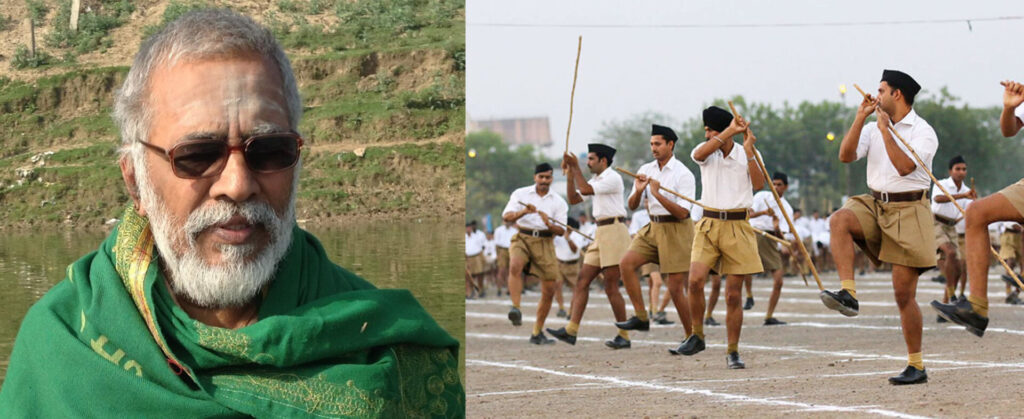
The Momentous Decision
Upon finishing high school, Sarma Sastrigal’s father decided to take him out of formal education, enrolling him instead in shorthand and typewriting classes. Soon, he was sent to Madras (now Chennai) to join his elder brother, an engineer at the Port Trust, with the expectation that he would secure a stable job and support the family.
Sarma Sastrigal found employment at Vanguard Insurance Company, which later merged with LIC (Life Insurance Corporation of India). It was a well-paying position, and his initial goal was simple — to earn, contribute to his family’s financial stability, and build a career.
But fate had other plans.
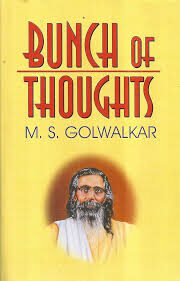
In Chennai, he instinctively sought out an RSS shakha. While his day job kept him occupied, his evenings were devoted to Sangh activities. It was during this period that he came across ‘Bunch of Thoughts’ (Vichardhara), a book by Madhav Sadashiv Golwalkar, fondly called ‘Guruji’ by all.
Golwalkar, affectionately called Guruji, articulated the vision of the RSS with clarity:
- Revival of Hindu culture after centuries of foreign rule
- National unity beyond caste, creed, and language
- Dedication, discipline, and selfless service as the foundation of a strong society
The book stirred something deep within Sarma Sastrigal. He saw the RSS as a unifying force, working towards strengthening India’s cultural fabric. The idea of self-sacrifice for a national cause resonated strongly — just like a soldier giving up personal comforts to protect the country, an RSS worker dedicated his life to social upliftment and unity.
Embracing the RSS Way
At twenty, Sarma Sastrigal made a defining choice. The ideology of the RSS was no longer just something he believed in — it was his calling. The India-China war had ignited his sense of duty, but his time with the RSS in Chennai cemented his commitment.
Life has a way of showing each of us our path — it is up to us to recognize the signal and act on it. For Sarma Sastrigal, that signal was clear. The RSS had given him a purpose, a structure, and a mission. His journey as a Sangha pracharak was only beginning.
Sarma Sastrigal’s journey into the RSS was shaped by a series of inspiring events and influences that fuelled his passion for national service. Born into a traditional family, he was raised with strong values of discipline, dedication, and patriotism. His early years were spent observing the ideals of social service and cultural preservation, which later guided his life choices.
One of the defining moments in his ideological formation was an encounter with the story of Mahatma Gandhi’s visit to an RSS camp. In December 1934, during an RSS winter training camp at Jamnalal Bajaj’s farm in Wardha, Gandhiji, who was staying at the nearby Satyagraha Ashram, expressed interest in visiting the camp. Accompanied by Miraben, Mahadev Desai, and others, Gandhiji witnessed the discipline and unity among the swayamsevaks, cutting across caste lines. His surprise at their inclusivity and the structured organization of the RSS left a lasting impression on Sarma Sastrigal, reinforcing his admiration for the Sangh’s work
As he grew older, his interest in the RSS deepened. The influences of strong leaders such as Dr. Hedgewar and M. S. Golwalkar further strengthened his conviction. His career took off in a different direction, and he initially followed a conventional path, securing a stable job. However, the yearning to contribute to the nation never left him. In 1970, a pivotal moment arrived when Sri Rama Gopalan (Gopalji) asked him to become a full-time pracharak for the RSS. Without hesitation, he accepted the call, realizing that his true purpose lay in selfless service to the nation.
This decision marked a turning point in his life. Leaving behind the comforts of a secure career, he embraced the rigorous life of an RSS pracharak. The role demanded complete dedication — renouncing personal aspirations, severing ties with family, and committing wholly to the organization’s mission. Unlike swayamsevaks, who could marry and lead family lives, pracharaks lived a life akin to renunciation, entirely focused on their work for the Sangh.
Despite facing initial resistance from his family, particularly his father, who was concerned about financial responsibilities and familial obligations, Sarma Sastrigal remained resolute. He assured his family that he would dedicate only five years to the RSS before reconsidering his path. His journey as a pracharak was marked by relentless travel, organizing shakas, and spreading the ideals of national unity and Hindu cultural resurgence.
His work took him across Tamil Nadu, where he interacted with people from all walks of life, conducting awareness programs and fostering a spirit of selfless service. Though the path was arduous — requiring extensive travel, minimal personal comforts, and complete immersion in the RSS’s mission — he found immense satisfaction and inner peace in his work.
Looking back, Sarma Sastrigal regards those five years as among the most fulfilling of his life. His contributions to the RSS and his tireless efforts in uniting people under the banner of cultural nationalism remain a testament to his unwavering commitment. His story is one of dedication, sacrifice, and a deep-rooted love for the nation — an inspiration to all who seek to serve a greater cause.
In the midst of making a major life decision, Sarma Sastrigal sought the darshan of Maha Periyava, hoping to receive the blessings of the great Maha Periyava for his future. On the morning before his scheduled departure to Madurai, he decided to visit the Sri Kanchi mutt in Kanchipuram. As he made his way to the temple, his mind was a whirlwind of thoughts. He felt a sense of excitement, knowing that he was embarking on a path that would align with the values Maha Periyava held dear. Maha Periyava had often praised the dedication of young individuals to social causes, and Sarma Sastrigal believed that his decision would earn Maha Periyava’s blessing.
After two hours of waiting, Sarma Sastrigal finally had his audience with Maha Periyava. When he shared his decision with Maha Periyava – to resign from his job and join the Rashtriya Swayamsevak Sangh (RSS) as a pracharak – Maha Periyava expressed concern for his family. “Isn’t your family a large one?” Maha Periyava asked. Upon learning that Sarma Sastrigal was one of six children, Periyava advised him to reconsider. He pointed out the financial strain that could result from his decision, as his family was reliant on the modest income of his father and elder brother. With great compassion, Maha Periyava gently suggested that Sarma Sastrigal should seriously reflect on his decision before proceeding. Sri Maha periyava looked at Sarma Satrigal with the grace and affection for which he is known, and gave him prasadam – his way of indicating that the chat was over.
This moment left Sarma Sastrigal stunned. Maha Periyava’s words caused him to question his choice, but his determination to follow through remained unshaken. He recognized that this was a test – a challenge to ensure his commitment was genuine. Despite the doubt planted in his mind, Sarma Sastrigal stayed firm in his resolve, boarded the train to Madurai that evening, and began his journey with the RSS.
Years later, while reflecting on his path, Sarma Sastrigal confided in his guru, Sankaranji, about the lingering guilt he felt for not following Maha Periyava’s advice. He spoke of the feeling that he had transgressed by not reconsidering his decision as Maha Periyava had suggested. Sankaranji, known for his frankness, assured him that he had not disobeyed Periyava. He explained that Maha Periyava’s advice was a test – a way to see if Sarma Sastrigal’s commitment to his decision was resolute. Maha Periyava’s gaze of compassion and the offering of prasadam after the conversation were indications that Sarma Sastrigal’s decision had earned Periyava’s approval.
This revelation brought Sarma Sastrigal immense relief, dispelling the lingering doubt that had haunted him. In his years with the RSS and beyond, he came to understand that the guidance of Maha Periyava was not a deterrent but a reaffirmation of his dedication. The experience solidified his belief in the strength of his choices and the value of pursuing one’s convictions with sincerity and purpose.
The Pracharak Years in Kanyakumari
After completing his Sangha Shiksha Varga (RSS training camp) in Madurai, Sarma Sastrigal received his first posting to Kanyakumari. Vishwaketu, the zilla pracharak of the region, introduced him to his new responsibilities, which included overseeing three taluks: Kuzhiturai, Vilavangod and Thakkalai. His headquarters was located in Thakkalai, a place that would later become central to his work.
Upon arrival, Sarma Sastrigal found the local area to be a stronghold of Communist influence, with significant resistance and hostility towards the RSS. There was also opposition from the large Christian community in the area. However, undeterred by the challenges, Sarma Sastrigal dove into his work with characteristic enthusiasm and fearlessness. His interactions with local Sangha workers, particularly Mr. Kumaraswami, the karyavaha in Brahmapuram, were marked by warmth and acceptance, reflecting the friendliness that he had witnessed in his own father’s relationships with pracharaks.
Despite the resistance, Sarma Sastrigal quickly established shakhas in Thakkalai, Vilavangod, and Monday Market. His work in these areas was not without its risks. Ramachandran, zilla karyavaha in Thalakkulam was a huge help and took care of many things. A Communist firebrand openly threatened his life, vowing to take it if Sarma Sastrigal dared to open a shakha the next day. However, in a twist of fate, this threat was met with a life-saving act of compassion. That same night, Sarma Sastrigal helped the man’s child, who was suffering from a medical emergency, securing prompt treatment and saving the child’s life. The following day, the man who had once threatened him arrived at the shakha and, to Sarma Sastrigal’s astonishment, expressed his remorse and offered to protect him from any future harm.
This event marked a significant turning point, not just in the relationship between Sarma Sastrigal and his antagonist, but also in the local community’s perception of the RSS. It became clear that the RSS’s commitment to service, rather than political or religious agendas, had touched the hearts of the people. The shift was not merely due to the personal act of kindness but also because Sarma Sastrigal had responded to the threat with calmness and dignity, in true RSS fashion.
As Zilla Pracharak in Ramanathapuram District
After his successful tenure in Kanyakumari, Sarma Sastrigal was promoted to Zilla Pracharak for Ramanathapuram district. It stretched from Paramakkudi and Rameswaram on one side to Tiruppatthur, Kunrakkudi and Karaikudi on another and Aruppukkottai, Virudhunagar and Rajapalayam on the third side. In this new role, Sarma Sastrigal’s responsibilities expanded as he managed RSS activities across a large and diverse geographical area. He worked tirelessly to expand the Sangha’s influence, often travelling across the district and engaging with people from all walks of life, without bias or prejudice.
Despite the hardships, including limited financial resources and a lack of basic amenities, Sarma Sastrigal’s commitment to the cause only deepened. His days were spent visiting villagers, roadside shopkeepers, and local artisans, while also interacting with political leaders, councillors, and authorities. His work in these areas often meant going without meals, relying on the kindness of strangers, and learning to endure physical discomforts in pursuit of the greater good. This period, which lasted for over four years, proved to be transformative for Sarma Sastrigal, as it solidified his mental resilience and strengthened his ability to navigate challenges with a calm, solution-oriented mindset.
Inspirational Sangha Leaders in My Life
During his time as Zilla Pracharak, Sarma Sastrigal had the opportunity to meet and work closely with several towering figures within the RSS, such as Guruji Golwalkar, Balasaheb Deoras, Yadav Rao Joshi, and others. These leaders, who had dedicated their lives to the service of the nation, served as both mentors and sources of inspiration for Sarma Sastrigal. Their selflessness and commitment to the cause left a lasting impression on him, shaping his understanding of the importance of community service and nation-building.
Sarma Sastrigal also worked closely with local RSS karyakartas and helped groom future leaders. One such individual was R. Vanniyarajan, a young man who started as a Mukhya Shikshak (head teacher) and later rose to become a key figure in the RSS, eventually overseeing the entire Tamil Nadu and Kerala regions.
The period of the Emergency in 1975, when the Indian government, under Prime Minister Indira Gandhi, imposed authoritarian rule, brought new challenges to the RSS. Sarma Sastrigal received word that the police were looking for him, planning to arrest him under the Maintenance of Internal Security Act (MISA) due to his involvement with the RSS. Far from being intimidated, Sarma Sastrigal felt exhilarated. To him, the attention of the government was a recognition of the RSS’s growing influence and a confirmation that their efforts were being taken seriously…